Volume: 5 Issue: 2 June 2025
FULL TEXT
Z-Plasty Planning for Single-Session Release of Parallel Linear Burn Contractures
ABSTRACT
Burn contractures can greatly impair mobility, particularly when multiple parallel linear bands develop in mobile anatomical regions. Conventional management often requires staged procedures to preserve flap viability, which may prolong treatment. In this study, we describe a standardized Z-plasty planning method that enables single-session release of 2 or more parallel contracture bands without compromising circulation. Between 2020 and 2024, 8 patients with burn contractures were treated at our institution, of whom 2 with parallel linear bands were included in this report. One patient presented with 3 parallel neck bands and the other with 2 thigh bands. All contractures were successfully released using the proposed technique, with no intraoperative or postoperative complications. Patients demonstrated improved mobility, reduced tension, and stable outcomes on follow-up. Our findings suggest that simultaneous Z-plasty release of multiple parallel burn contractures is both feasible and safe when proper surgical planning principles are followed, offering favorable functional results and reducing the need for staged interventions.
KEY WORDS: Flap, Mobility, Reconstruction, Tension, Viability
INTRODUCTION
Burn contractures limit joint mobility by creating skin tension over affected regions. The development and severity of contractures depend on factors such as burn depth, wound healing mechanisms, compression therapy during the remodeling phase, and patient adherence to rehabilitation programs. Although single or broad linear contractures are common, parallel multiple linear bands can also be seen, particularly in the neck and extremities. Conventional approaches, including single or multiple Z-plasties, are effective for isolated bands, whereas other reconstructive options such as rhomboid or perforator flaps have also been described.1-4 However, simultaneous release of multiple parallel bands via Z-plasty may raise concerns about flap viability. We propose a standardized approach that enables single-session release of 2 or more parallel bands without compromising flap circulation.
MATERIALS AND METHODS
Surgical planning
The central Z-plasty axis is marked between parallel contracture bands at a predetermined angle (45°, 60°, 90°, or 120°). This determines limb length. Each Z-plasty limb must cross at least 1 contracture band. For optimal release, the length of each band should exceed the interband distance (Figure 1 and Figure 2).
Patient selection
Between 2020 and 2024, 8 patients with burn contractures were treated at the Department of Plastic Surgery, Başkent University Faculty of Medicine (Ankara, Turkey). Two of these patients presented with parallel linear bands and were included in this study. One patient had 3 parallel neck bands, and the other patient had 2 bands in the lower extremity (Table 1).
RESULTS
All contractures were released successfully by using our planned Z-plasty approach. The included patients had no early or late complications. The patients reported reduced tension and improved mobility. Early mobilization protocols were implemented to prevent recontracture, and follow-up visits confirmed stable outcomes.
DISCUSSION
Burn contractures remain a challenging sequela of thermal injuries, particularly when multiple parallel linear bands develop in anatomically mobile regions. Conventional surgical management often targets each contracture band individually, which may necessitate staged operations to preserve flap viability.1,2 Our series demonstrates that carefully planned simultaneous Z-plasty releases can be performed safely in selected patients without compromising vascularity, provided that certain technical principles are respected.
The success of our technique lies in accurate preoperative planning, particularly in selecting the appropriate Z-plasty angles and ensuring that each flap limb traverses a contracture band. This approach maximizes scar lengthening while minimizing undue tension on any single flap segment. Similar strategies have been suggested in the literature, where modifications of the classical Z-plasty, such as the 5-flap and dual opposing Z-plasties, have been used to address complex contracture patterns.2,3 However, reports specifically addressing the simultaneous release of multiple parallel bands in a single stage are scarce.
Our findings support the principle that adequate flap perfusion can be maintained even when multiple adjacent Z-plasties are performed, provided that interflap spacing and vascular territories are preserved. Early mobilization in the postoperative period further enhances outcomes and may reduce the risk of recontracture, thus aligning with established rehabilitation protocols in burn reconstruction.4
The main limitation of our study was the small sample size, which precluded definitive statistical conclusions. Future studies with larger cohorts and longer follow-up periods are needed to validate the reproducibility and durability of this method.
CONCLUSIONS
Our standardized Z-plasty planning method appears to be an effective and safe approach for releasing 2 or more parallel linear burn contractures in a single session, with favorable functional outcomes.
REFERENCES
- Donelan MB, Buta MR. The art of local tissue rearrangements in burn reconstruction: Z-plasty and more. Clin Plast Surg. 2024;51(3):329-347. doi:10.1016/j.cps.2024.03.004
- Ersoy B. A new flap design for release of parallel contracture bands: dual opposing five-flap z-plasty. Burns. 20142;40(8):e69-e71. doi:10.1016/j.burns.2014.05.011
- Yang C, Yang Y, Zhong W, Li B, Li F. Comparison study of 5-flap Z-plasty and double Z-plasty for interdigital pocket web contractures. J Hand Surg Am. 2024;49(10):1033.e1-1033.e7. doi:10.1016/j.jhsa.2022.11.011
- Atiyeh BS, Hayek SN, Gunn SW. New technologies for burn wound closure and healing—Review of the literature. Burns. 2005;31(8):944-56. doi:10.1016/j.burns.2005.08.023.

Volume : 5
Issue : 2
Pages : 34 - 36
DOI : 10.6002/bcp.2025.0008
From 1Baskent University Faculty of Medicine, Plastic, Reconstructive and Aesthetic Surgery, Ankara, Turkey, and 2Baskent University Faculty of Medicine, General Surgery, Ankara, Turkey
ACKNOWLEDGEMENTS: The authors have not received any funding or grants in support of the presented research or for the preparation of this work and have no declarations of potential conflicts of interest..
CORRESPONDING AUTHOR: Abdullah Kızmaz, Baskent University Faculty of Medicine, Plastic, Reconstructive and Aesthetic Surgery, Ankara, Turkey
E-mail: kzmazabdllah@gmail.com
PHONE: +90 539 482 6023
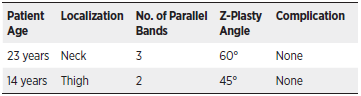
Table 1 Patient Characteristics
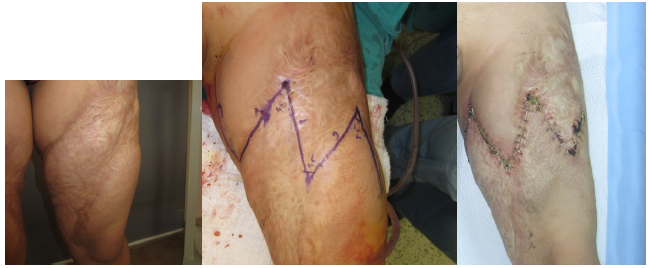
Figure 1 Release of 2 Parallel Contracture Bands in the Lower Extremity Using Z-Plasty
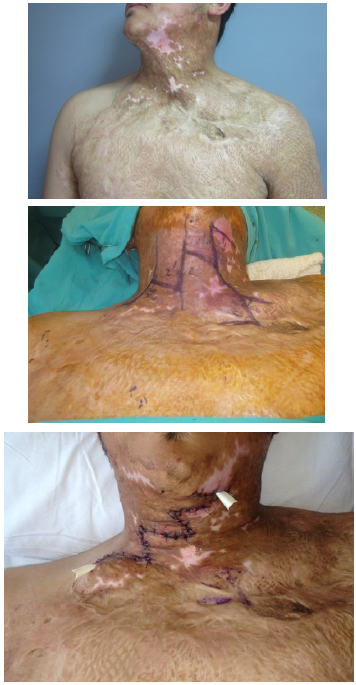
Figure 2 Release of 3 Parallel Contracture Bands in the Neck Using Z-Plasty