Volume: 4 Issue: 2 June 2024
FULL TEXT
ABSTRACT
OBJECTIVES: We reported results of surgical management of limbal stem cell deficiency secondary to chemical ocular burns.
MATERIALS AND METHODS: We retrospectively reviewed medical records of patients who had surgery with the diagnosis of limbal stem cell deficiency from chemical burns between January 2016 and January 2023. Patients with follow-up of more than 6 months were included. We recorded demographic properties, best-corrected visual acuity at preoperative and last visits, medical and surgical treatment modalities, and outcomes.
RESULTS: Nineteen eyes of 13 patients (9 males, 4 females) were included; mean age was 35.7±14.2 years. Limbal stem cell deficiency was bilateral in 6 cases. Mean time from injury to medical treatment was 13.3 ± 8.1 months (range, 4-23 mo). Six patients had bilateral involvement: 3 received living-related conjunctival allograft transplant, and 3 received deceased donor keratolimbal allograft transplant. Seven cases had unilateral involvement, 4 of which underwent conjunctival limbal autograft transplant and 3 had simple limbal epithelial transplant. Mean postoperative follow-up was 25.8 ± 16.6 months (range, 5-42 mo). Corneal transplant was performed simultaneously in 4 patients and 1 and 2 years after limbal stem cell transplant in 5 other patients. At the last visit, 13 eyes (68.4%) had intact and stable ocular surfaces with clear central corneas. Mean best-corrected visual acuity increased from 1.65 ± 0.93 to 0.78 ± 0.65 logMAR at last visit (P < .001).
CONCLUSIONS: Treatment and restoration of the ocular surface health are challenging in limbal stem cell deficiency due to chemical injury to the ocular surface. Living-related conjunctival allograft transplant and cadaveric keratolimbal allograft transplant are currently available surgical techniques in bilateral cases. Unilateral cases can be managed with newer techniques such as simple limbal epithelial transplant, allowing the in vivo expansion of limbal stem cells on an amniotic membrane transplant.
KEY WORDS: Limbal stem cell transplant, Ocular burn injury, Ocular Surface
INTRODUCTION
Limbal stem cells are located at the limbus and are the progenitor cells of the corneal epithelium. Cornea becomes vascularized and opaque in limbal stem cell deficiency (LSCD). Corneal transplant alone is unsuccessful in patients with LSCD, and transplant must be combined with limbal stem cell transplant (LSCT) for an optimum outcome. Limbal stem cell deficiency may occur secondary to severe dry eye, chronic inflammation of the ocular surface, chemical burns, or Stevens-Johnson syndrome or may occur from congenital reasons such as congenital aniridia.
Chemical eye injuries comprise 11.5% to 22.1% of ocular traumas, and two-thirds of cases are young male patients. Children aged 1 to 2 years are particularly at risk.1 Most chemical ocular burns occur in industrial accidents. The most common causative agents are ammonia, potassium hydroxide, lye, magnesium hydroxide, and lime. Alkali agents are lipophilic and therefore penetrate tissues more rapidly than acids. They saponify the fatty acids of cell membranes and cause cellular damage. Damage to limbal stem cells on the ocular surface can cause varying degrees of LSCD, according to exposure severity and duration.
Surgical treatment of LSCD can be performed by contralateral conjunctival limbal autograft transplant or simple limbal epithelial transplant (SLET) in unilateral cases. In bilateral cases, a keratolimbal allograft procedure from a deceased donor coupled with systemic immunosuppression or limbal allograft taken from a living related donor who is HLA compatible can be performed2 (Figure 1). Here, we report the results of surgical management of LSCD secondary to chemical ocular burns.
Materials and Methods
We retrospectively reviewed medical records of patients who had surgery with the diagnosis of LSCD from chemical burns between January 2016 and January 2023. Patients with follow-up of more than 6 months were included. We recorded demographic properties of the patients, best-corrected visual acuity at the preoperative visit and last visit, medical and surgical treatment modalities, and their outcomes. A successful outcome was defined as increase in visual acuity and a clear cornea in the central 6 mm without epithelial defects.
Results
We reviewed results of 19 eyes of 13 patients; mean age of patients was 35.7 ± 14.2 years. The group included 9 male patients and 4 female patients. Six patients had bilateral LSCD. The mean time from injury until surgery was 13.3 ± 8.1 months (range, 4-23 mo). Treatment modalities used during this period included topical corticosteroids, topical cyclosporin A, autologous serum eye drops, vitamin A ointment, topical anti-vascular endothelial growth factor agents, and frequent use of nonpreserved artificial tears. Punctal plugs were used in 2 patients.
Among the 6 patients with bilateral LSCD, 3 patients received living-related donor conjunctival allograft transplant, and 3 patients received deceased donor keratolimbal allograft transplant. Figure 2 shows the preoperative and postoperative images of a patient with ocular surface damage due to alkali burn, who underwent deceased donor keratolimbal allograft transplant, amniotic membrane transplant, and penetrating keratoplasty. Among the 7 patients with unilateral involvement, 4 patients underwent conjunctival limbal autograft transplant and 3 had SLET.
The mean postoperative follow-up duration was 25.8 ± 16.6 months (range, 5-42 mo). Corneal transplant was performed simultaneously in 4 patients and at 1 or 2 years after LSCT in 5 other patients. One patient developed fungal keratitis on the corneal graft tissue and underwent a second keratoplasty at 9 months postoperatively. Simultaneous amniotic membrane transplant was performed in 6 patients. At the last recorded visit, 13 eyes (68.4%) had an intact and stable ocular surface with clear central cornea. The mean best-corrected visual acuity increased from 1.65 ± 0.93 to 0.78 ± 0.65 logMAR at the last recorded visit (P < .001).
Discussion
Treatment and restoration of ocular surface health have remained challenging in patients with LSCD because of the chemical injury that occurs to the ocular surface. Living-related donor conjunctival allograft transplant and deceased donor keratolimbal allograft transplant are the currently available surgical techniques for bilateral cases. Unilateral cases can be treated with newer techniques such as SLET, allowing the in vivo expansion of limbal stem cells on an amniotic membrane transplant.3 The choice of therapy also depends on the stage of LSCD, as proposed by the International LSCD Working group.4 If the central visual axis is not involved or the patient is asymptomatic, medical treatments that optimize the ocular surface, as described above, are often sufficient and surgical intervention in such cases is not necessary. For eyes in which the vision is severely compromised and for patients with severe LSCD, such as stages IIB and III diseases, surgical treatment is often necessary to stabilize the ocular surface and improve visual function.
Many surgical treatment options with various advantages and risks have been reported. A treatment algorithm for use in selecting an appropriate type of surgical treatment has been described by the International Limbal Stem Cell Deficiency Working Group.4 For patients in this study, we aimed to optimize the ocular surface before LSCT therapy; optimization was achieved by treating any associated ocular surface diseases such as dry eye disease, eyelid or conjunctival abnormalities, and ocular surface inflammation. Autologous LSCT procedures using the least amount of donor tissue, such as SLET, ex vivo–cultivated autologous LSCT, and modified conjunctival limbal autografting, are preferred over other surgical treatments for unilateral or subtotal bilateral LSCD or whenever feasible because of better long-term outcomes and fewer complications.
For the treatment of total bilateral LSCD with good eyelid and tear function, options include allogeneic LSCT, cultivated oral mucosal explant transplant, ex vivo–cultivated autologous conjunctival epithelial cell transplant, and keratoprosthesis.5 In cases of severe bilateral ocular surface disease, the type of surgical treatment for the management will be selected based on the availability of the treatment, the experience of the surgeon, any contraindications to systemic immunosuppression, and the preference of the patient. Tissue engineering or newer tissue culturing techniques are bound to play a substantial role in the future of LSCD treatment.
REFERENCES
- Haring RS, Sheffield ID, Channa R, Canner JK, Schneider EB. Epidemiologic trends of chemical ocular burns in the United States. JAMA Ophthalmol. 2016;134(10):1119e24. doi:10.1001/jamaophthalmol.2016.2645
CrossRef - PubMed - Vazirani J, Mariappan I, Ramamurthy S, Fatima S, Basu S, Sangwan VS. Surgical management of bilateral limbal stem cell deficiency. Ocul Surf. 2016;14(3):350-364. doi:10.1016/j.jtos.2016.02.006
CrossRef - PubMed - Dong Y, Peng H, Lavker RM. Emerging therapeutic strategies for limbal stem cell deficiency. J Ophthalmol. 2018;2018:7894647. doi:10.1155/2018/7894647
CrossRef - PubMed - Deng SX, Kruse F, Gomes JAP, et al; the International Limbal Stem Cell Deficiency Working Group. Global consensus on the management of limbal stem cell deficiency. Cornea. 2020;39(10):1291-1302. doi:10.1097/ICO.0000000000002358
CrossRef - PubMed - Liu J, Sheha H, Fu Y, Giegengack M, Tseng SC. Oral mucosal graft with amniotic membrane transplantation for total limbal stem cell deficiency. Am J Ophthalmol. 2011;152:739-747.e1. doi:10.1016/j.ajo.2011.03.037
CrossRef - PubMed

Volume : 4
Issue : 2
Pages : 42 - 44
DOI : 10.6002/bcp.2024.0008
From the 1Department of Ophthalmology and the 2Department of General Surgery and Burn and Fire Disaster Institute, Baskent University Faculty of Medicine, Ankara, Turkey
Acknowledgements: The authors have not received any funding or grants in support of the presented research or for the preparation of this work and have no declarations of potential conflicts of interest.
Corresponding author: Dilek Dursun Altınörs, Fevzi Cakmak cad. 10. Sok No:45, Bahcelievler, Cankaya, Ankara, Turkey
E-mail: dilek.dursun@gmail.com
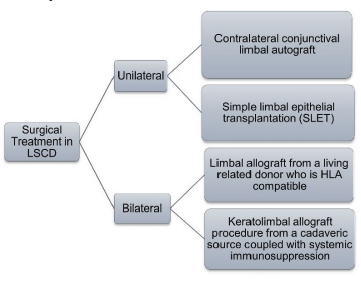
FIGURE 1 Surgical Options for Treatment of Limbal Stem Cell Deficiency
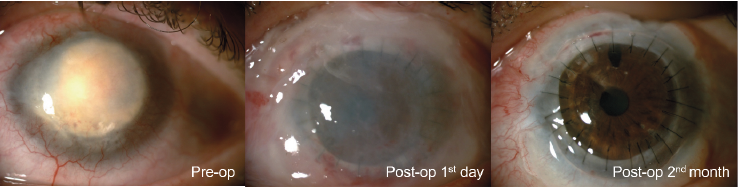
FIGURE 2 Preoperative and Postoperative Images of a Patient With Ocular Surface Damage From Alkali Burn Who Underwent Deceased Donor Keratolimbal Allograft Transplant, Amniotic Membrane Transplant, and Penetrating Keratoplasty