Volume: 5 Issue: 2 June 2025
FULL TEXT
Evaluation of the Effect of Time Elapsed After Burn Injury on Perforator Flap Success
ABSTRACT
OBJECTIVES: Burn injuries frequently necessitate complex reconstruction when vital structures are exposed and skin grafting is not feasible. Pedicled perforator flaps, which provide well-vascularized tissue with minimal donor site morbidity, have become an important option in both acute and late burn management. This study aimed to evaluate outcomes of pedicled perforator flaps and assess the effect of time elapsed between injury and surgery on flap survival.
METHODS AND RESULTS: We studied 25 pedicled perforator flaps performed in 20 patients (17 male, 3 female). Patients were divided into 2 groups: acute phase (≤21 days postinjury) and late phase (21 days-1 year postinjury). No flap loss was observed in the acute phase. In the late phase, 2 total flap losses occurred (1 supraclavicular artery perforator flap, 1 superior epigastric artery perforator flap), and 1 partial necrosis developed in a superior gluteal artery perforator flap with a 180° rotation.
CONCLUSIONS: Pedicled perforator flaps demonstrated high reliability in both acute and late phases. The absence of flap loss in early reconstructions suggests a more favorable vascular environment, whereas complications in late reconstructions may be related to scar tissue, pedicle torsion, or compromised circulation. Pedicled perforator flaps are a safe and effective reconstructive option in burn injuries. Early application may yield higher survival rates, while late-phase procedures demand meticulous preoperative vascular assessment.
KEY WORDS: Burn complications, Flap surgery, Pedicled perforator flap
INTRODUCTION
Flaps are defined as volumes of tissue transferred with an intact blood supply, in contrast to grafts, which require revascularization from the recipient bed. Flaps are classified according to their vascular supply, method of transfer, and constituent tissue type.1 Perforator flaps are supplied by perforating vessels that branch from major arteries and traverse muscle fascia or intermuscular septa to reach the overlying tissues. Each perforator has a defined vascular territory, providing consistent perfusion to the flap.2 Once islanded and dissected free of surrounding attachments, except for its vascular pedicle, a perforator flap can be advanced or rotated into the defect.3
Flap surgery is indicated when skin grafting is not feasible, such as in the presence of exposed musculoskeletal or neurovascular structures in the acute burn setting.4 In the late phase of burn management, flaps are utilized to address complications including contractures, hypertrophic scars, and Marjolin ulcers (Figure 1).5 Although experimental studies have supported the reliability of local flaps elevated adjacent to the burn zone, reconstruction with perforator flaps offers a higher likelihood of success due to the transfer of healthy, well-vascularized tissue (Figure 2).
In this study, we present clinical experience with pedicled perforator flaps in both the acute and chronic phases of burn injury and assessed the influence of the interval between injury and flap reconstruction on surgical outcomes.
METHODS AND RESULTS
We collected information on 25 pedicled perforator flap procedures performed in 20 patients (17 male patients, 3 female patients) for burn injury reconstruction. We categorized patients into 2 groups according to timing of surgery: acute phase (within the first 21 days after injury) and late phase (between 21 days and 1 year after injury) (Table 1).
No flap loss occurred in the acute phase. In the late phase, 2 cases of total flap loss were observed (1 supraclavicular artery perforator flap, 1 superior epigastric artery perforator flap). Partial necrosis developed in 1 flap with a 180° rotation (superior gluteal artery perforator flap) (Figure 3).
DISCUSSION
Pedicled perforator flaps have become a valuable reconstructive option in burn surgery because they provide well-vascularized tissue with minimal donor site morbidity while preserving major vascular structures. Their versatility and reliability have been highlighted in multiple studies, particularly in situations where skin grafting is not feasible.1,4
Our findings indicated that flap survival is higher in the acute phase of burn management, as no flap loss was observed when surgery was performed within 21 days post-injury. In contrast, flap loss and partial necrosis occurred in patients reconstructed during the late phase. This observation is consistent with prior reports suggesting that early reconstruction benefits from a more favorable vascular environment, with less scar tissue and fibrosis impairing circulation.2,5 In late reconstructions, compromised tissue perfusion, scarring, and technical challenges, such as pedicle torsion, increase the risk of complications.
The reliability of perforator flaps even in complex burn cases has been emphasized by others, who note that meticulous planning, careful intraoperative dissection, and preservation of perforator integrity are essential for successful outcomes.3,4 Our results reinforce these principles, demonstrating that, with proper technique, pedicled perforator flaps remain a dependable option in both early and late settings.
The main limitation of our study was the relatively small sample size, which restricts generalizability and prevents definitive statistical conclusions. Future studies with larger cohorts and long-term follow-up are warranted to confirm the observed trend that early flap reconstruction yields superior outcomes compared to delayed procedures.
REFERENCES
- Blondeel PN, Van Landuyt KH, Monstrey SJ, et al. The “Gent” consensus on perforator flap terminology. Plast Reconstr Surg. 2003;112(5):1378-1383. doi:10.1097/01.PRS.0000081071.83805.B6
- Saint-Cyr M, Wong C, Schaverien M, Mojallal A, Rohrich RJ. The perforasome theory: vascular anatomy and clinical implications. Plast Reconstr Surg. 2009;124(5):1529-1544. doi:10.1097/PRS.0b013e3181b98a6c
- Koshima I, Soeda S. Inferior epigastric artery skin flaps without rectus abdominis muscle. Br J Plast Surg. 1989;42(6):645-648. doi:10.1016/0007-1226(89)90075-1
- Atiyeh BS, Hayek SN, Gunn SW. New technologies for burn wound closure and healing--review of the literature. Burns. 2005;31(8):944-956. doi:10.1016/j.burns.2005.08.023
- Panse N, Sahasrabudhe P, Bhatt Y. Use of local perforator flaps for post burn reconstruction. World J Plast Surg. 2012;1(1):22-29.

Volume : 5
Issue : 2
Pages : 31 - 33
DOI : 10.6002/bcp.2025.0007
From the 1Department of Plastic, Reconstructive and Aesthetic Surgery and the 2Department of General Surgery and Burn and Fire Disaster Institute, Baskent University, Ankara, Türkiye
ACKNOWLEDGEMENTS: The authors have not received any funding or grants in support of the presented research or for the preparation of this work and have no declarations of potential conflicts of interest.
CORRESPONDING AUTHOR: Aykut Baycık, Department of Plastic, Reconstructive and Aesthetic Surgery, Baskent University, Ankara, Türkiye
E-mail: aykut_baycik@hotmail.com
PHONE: +90 539 921 1593
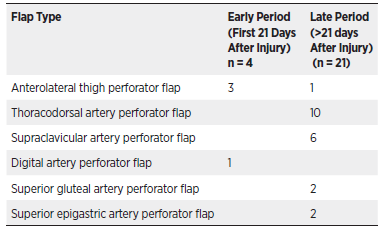
Table 1 Number and Timing of Performed Perforator Flaps
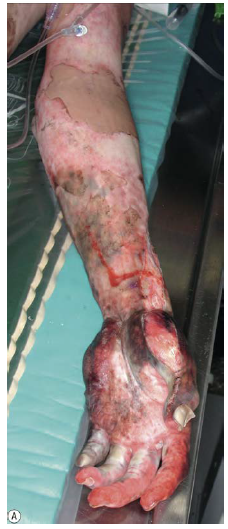
Figure 1 Left Forearm and Hand Wound With Macroscopical Fungal Growth (a white, fluffy appearance) and Necrotic Borders Before Repeated Surgical Debridement.
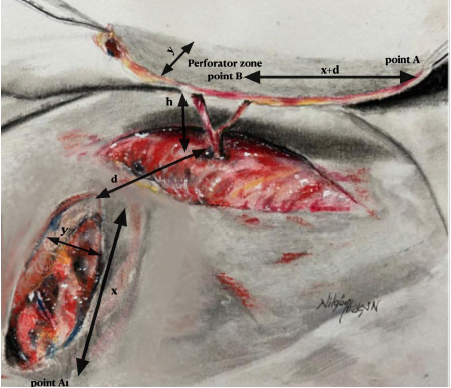
Figure 2 Use of Perforator Flap
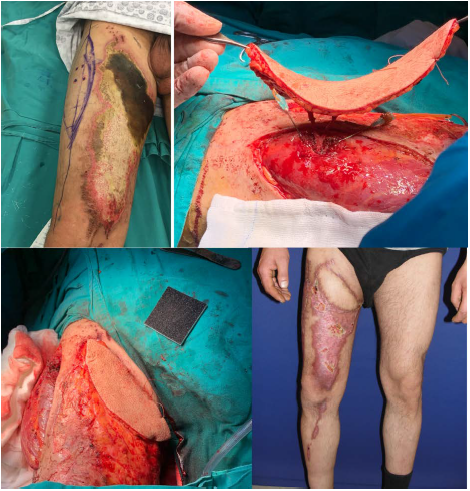
Figure 3 Partial Necrosis Observed in a Superior Gluteal Artery Perforator Flap with a 180° Rotation, Performed for Burn Reconstruction